

An Introduction To Singleton Planets
When looking at a chart from the point of view of psychological astrology, we attempt to discern and describe the uniqueness of the individual. We look for the probable psychological processes that are likely to be taking place in that person’s life. We then engage in a dialogue with the person to find out at what level of consciousness he is functioning most of the time. We need to know something of the person’s background, such as education, career and recreational interests, marital status, religious and ethnic affiliations and so one. Is she from rural Africa, urban Asia, or suburban South America?
People with similar charts and different early environments will tend to use the energies shown in the chart differently, although their early perceptions may be quite similar. For example, a nominally Jewish man from New York and a Catholic man from Egypt have similar charts. They have similar tastes (love the game of bridge and gambling on horses or the tables in Las Vegas or Monte Carlo), and temperaments (volatile and explosive which has done damage to intimate and marriage relationships). Their choices of career and life path directions are very different. Both men have the same three planets as singletons, and they each have very unusual personalities!
The psychologist and the astrologer know that humans are paradoxical in nature. At one time and at one level of consciousness we are one way and then another. Some of our drives and urges conflict with each other and some cooperate. Many drives conflict with social conditioning. So we have both internal and external tension and struggle. Some parts of ourselves we like. Other parts we do not like, and still other parts we will not or cannot even admit to ourselves. The chart, however, shows the potential for wholeness.
Every chart shows the balance of comfort for the individual. We call that the Dominant Function. We feel natural, comfortable and at home with it. It is easy and natural, but may not be the source of any great motivation. For example, someone with a preponderance of Fire likes to play, enjoys entertainment, creative pursuits and leisure time. He may take early retirement to enjoy life, play with his grandchildren and hone his golf game, unless his work fulfills his or her creative urges, such as artist or actor.
The other side of the balance, or imbalance, is called the Inferior Function. This shows up most noticeably as a singleton planet or a missing function, i.e. absence of planets in a modality, element or orientation. (There is a book out by Shirley Lyons Meier, “Elemental Voids, More than Meets the Eye”, which gives a good discussion of missing elements.) The Inferior Function can be a source of great motivation and creative expression. It is often like the irritating grain of sand that causes the oyster, in time, to produce a valuable pearl. The Inferior Function is like the pig of the litter, or the runt of the litter. It takes up a lot of the overall psychological energy or gets none or very little of it. The Inferior Function tends to show up and take over when we are under stress, tired or ill.
The great beauty of astrology is the enormous insight it can give when we keep to the simplicity of the planets, signs, houses and major aspects. Simplicity is the key. We can set aside all the “fancy embroidery,” the parts, the midpoints, asteroids, etc. Just look at the chart: what is there; what is not there. What is not there, or only minimally there, is just as powerful an influence as what is there.
Categories
Before going further, let’s look at the different categories to check out in the chart. The zodiacal signs are categorized and broken down in several different ways. In psychological astrology, the preponderance of planets in these categories, in a particular natal chart, give insight into the inherent qualities, talents, inhibitions and general tendencies of the person.
We all grow and change in the life process through time. The inherent natal balance shifts in correlation to the planetary progressions. Both natal and progressed tendencies are further reinforced or diminished, modified and changed by the planetary transits of any specific time frame.
The first three are the most familiar and commonly used categories for the signs and their corresponding houses (i. e. Aries, first house):
- Polarity: (Positive/Negative or Yang/Yin)
- Modality: (Cardinal, Fixed, Mutable)
- Element: (Fire, Air, Water, Earth)
- Orientation by Sign: Personal, Social and Universal
- Orientation by House: Personal, Social and Universal
Polarity

Air and Fire signs and the odd numbered houses are positive or yang. They are inclined toward extroversion, assertion of individuality, creativity, acting out or performing action. They tend to be more conscious and aware of their intentions and motivations. The Earth and Water signs and the even numbered houses are negative or Yin. They tend to flow and merge with the collective. They are passive, responsive and reactive. The are introverted and tend to function more from subconscious or unconscious motivations. They are more instinctual and emotional in their approach to life, while Fire and air are more intuitive and rational. (Intuitive in this context implies a kind of inspiration and sudden spontaneous insight of the Uranian Ah Ha! type as opposed to the Neptunian hunch feeling).
Modalities
The Quadruplicities of the zodiac signs represent the Modalities. Modality indicates the form, style or type of motion, or force, associated with the signs. In Eastern philosophy, these three qualities are called the three gunas.
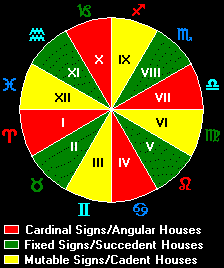 Cardinal is like centrifugal force which moves outward away from the center. It radiates outward by beginning or initiating action. It moves away from self toward others. It seeks outside of itself for fulfillment. It has difficulty ending and finishing. It is called rajas guna. The psychopathologies of Cardinal are paranoid tendencies and phobias. Look at Richard Nixon’s chart. He had a lot of Cardinal signs and houses, and he “was not a crook” but had “enemies.” Remember, whatever it is, it is always “out there” with Cardinal. Nixon was his own worst enemy.
The Fixed quality represents centripetal motion, drawing in from the periphery to the center. This can be considered magnetism. The quality of inertia or tamas guna, is associated with these signs. They are stable, hold onto the status quo and are good at follow-through and completion. They have difficulty with beginning or initiating and with making changes. They tend to be at rest and stay at rest, but once in motion, tend to stay in motion along a particular track. The fixed psychopathology tends toward obsessive/compulsive disorders. Look at Bill Clinton’s chart. When backed into a corner over the Monica Lewinsky affair, he “stonewalled” and obsessed over the meaning of the words “is” and “sexual relations.”
The Mutable signs and houses have an alternating style of motion rather like the movements of an eggbeater or a sewing machine. They move both in and out. They change, disburse, distribute, and are of the nature of sattva guna. They have difficulty deciding which direction to take, and change their minds easily and often. The psychopathologies of the Mutable signs are hysteria, manic depression, and schizoid tendencies. An example was a very take-charge Virgo man who completely “lost it,” practically running around in circles, when his new car would not start. Finally, his eight-year-old daughter pointed out that he had to put the car in parking gear before it would turn on.
Elements
The Triplicities represent the Elements. The signs are arranged in complementary pairs of opposites: Fire opposes Air, and Water opposes Earth. Opposite signs are, of course, in the same Modality (i.e. Aries opposite Libra are both Cardinal). Their attraction and interaction tends to be creative, cooperative, and conducive to greater awareness. Fire inspires Air’s thinking, while Air fans Fire’s performance and creativity. Water moistens and softens Earth’s hardness, making it malleable and fertile. Earth gives form and structure to Water’s flowing emotions and channels its passion into practical and useful purposes.

Fire is creative and inspired. It represents life, liveliness, and the qualities called “spirit” and “elan vital.” The archetype of Fire is vital, joyous and free. It burns with passionate enthusiasm and is blessed with creative talent. The three Fire signs represent the pioneer and warrior, the leader or king, and the philosopher or high priest. Qualities of assertion, power, and strength, as well as intuitive comprehension are associated with Fire. It is characterized by a fun-loving desire for independence along with an orientation towards performance. It is warm, sometimes hot (in every sense of the word!), and extroverted. There is inherent generosity, nobility, and aspiration for the best and the highest in Fire. It lights things up and brightens every situation.
The psychopathologies of Fire tend toward violence, impulsive crimes of passion, and arson. To use business terms, Fire is entrepreneurial (Aries), managerial (Leo), and promotional (Sagittarius). Fire is the intuitive function according the psychology of C. G. Jung.
Air is rational, and mental. It is concerned with relationships between people, places and things. This, of course, involves the ability to see and create connections with or between related situations. A talent for logical communication in speaking and writing belongs to Air. It is both objective and very theoretical. Air analyzes (Gemini), synthesizes (Libra), and synergizes (Aquarius), data. The characteristics of taking pieces of information, putting them together in a harmonious way and making a post-logical leap into mentally seeing totally new ways of relating data is genius. Air is the mediator, for it can balance Fire’s intuitive aspirations with the clear thinking and logic that leads to Earth’s concrete end products. Air is co-operative because it sees how to balance different facets of relationships to each other, whether human relations or relationships of things in space and time. The theoretical scientist, the marriage counselor, and the interior decorator/designer employ this ability. The capacity for compromise is a part of co-operation.
Air’s crimes tend to be white-collar ones that depend on intelligence. It is also associated with ideologically motivated crimes such as propaganda and “agent provocateur” activities. Air is, of course, the thinking function in Jungian psychology.
Water is emotional and sensitive on the feeling level. It includes the whole spectrum of emotional reactions: love, affection, passion, hate, joy, fear, anger, rage, pride, excitement, and so on. Feeling emotions gives us the definite sense that we are alive! We love to listen to music because is moves us, helps our feelings to ebb and flow just like water. We enjoy movies and the theatre for the same reason. Drama, comedy, tragedy, scary horror stories cause us to feel intense emotions. The Water element is associated with pain, and that includes both suffering pain and inflicting pain on others. Water not only ebbs and flows, it also changes form from crystal (ice, Scopio), to liquid (rivers, oceans, Cancer), to gas (mist, cloud, Pisces). Our emotions move and change in a similar fashion. Feelings may be frozen in resentment, rushing in a torrent of passion, and floating in an amorphous cloud of bliss. The fine arts of painting, dance, and music are Water’s finest outlets for manifestation.
In Hindu Astrology, the Water signs are “moksha” signs. Final liberation comes when we purify the emotional nature and rise above the feeling level that we share with all other intelligent animals. The story of Jesus walking on the water symbolizes the overcoming of and rising above the emotional nature. It conveys the idea that Jesus had become “jivan mukta” – a man liberated while still in the body.
Water is irrational (non-rational), and motivated by delusions in its psychopathology. The crimes associated with it are instinctual crimes of passion, often involving cruelty. The Water element equates with what the Jungians call the feeling function.
Earth is physical and is concerned with the five senses. The senses bring us information about the outside world, the world of material reality. If we can smell it, touch it, taste it, hear it and see it, then it exists as “real.” We experience it. Earth is experiential. We know something is true because we have interacted with it on the sensory, and sometimes sensual, level. We don’t believe it out of emotional feeling like Water; we don’t theorize about it as Air does, and we don’t know it to be so because a divine inspiration told us so like Fire would. We have to have material proof through the senses. Earth is associated also with comfort and physical security. We want a roof over us, food on the table, and a little money in the bank. Substance and subsistence is Earthy. Our work routines and health habits need to be efficient and organized. All kinds of rituals and responsibilities belong to this element. Earth is practical and patient in its pursuits of ambitions and search for perfection and a place of position in the world.
Earth tends to commit pre-meditated crimes, and money is often the motive. That might include such activities as safecracking, professional burglary, and hired assassinations. Prostitution and drug dealing fall into the Earth pathologies because they cater to the public urge for sensation, sensuality and substance. In Jungian psychology, Earth is like the sensation function.
Orientation in Time and Space
The fourth and fifth categories, not so often used, are those of Orientation in time and space. These are Personal, Social, and Universal.

- The Personal signs and the corresponding houses are Aries, Taurus, Gemini, Cancer, and houses one through four.
- The Social signs and houses are Leo, Virgo, Libra, Scorpio, and houses five through eight.
- The Universal or Transpersonal signs and houses are Sagittarius, Capricorn, Aquarius, Pisces, and houses nine through twelve.
The Personal signs and houses tend to be psychologically primitive and instinctual. They are me oriented. And they are ruled by the pleasure-pain mechanism. They are inclined to be somewhat simple and naïve. In certain ways they can be childlike or childish. They may have blind spots, lacking the ability to have insight into their own or other’s motivations. They tend to believe automatically that everyone is like they are, or, if not, they should be. They are pre-moral in the sense that they lack awareness of others as separate and different egos, or selves. In extreme cases, this is the sociopath who can do correct behavior because he has learned what is expected and acceptable through observation. But there is no conscience, no inner motivation to do the right thing simply because it is the right thing (as a Universal sign would), or because of the awareness a Social sign would have: that to do otherwise might hurt someone, even himself.
The Social signs and houses are aware of others and concerned with how to get along. They are very I-Thou motivated. Relationships in time and space are the focus of their attention. They are not so concerned with taking care of themselves as with interaction. They want to be liked. They need to feel that they belong and are a part of society. Social signs are moral. They desire to participate with others. Werner Erhard, with most of his planets in Social signs, Virgo, Libra and Scorpio (see chart), used to say that an event was not meaningful to a person unless he shared it with another. Those with strongly Personal or Universal orientations had difficulty even understanding what he could mean by that! Social signs want to conform and be validated by a significant other or the social group. They adjust themselves to the pressures placed upon them by society. They have a need to reach out, to accept and be accepted by people. They are the “people who need people.” Leo and Virgo represent the adolescent phase, while Libra and Scorpio stand for the young adults, the ages between 21and 35.
The Universal, or Transpersonal signs and houses are post-moral. Here, the perspective has widened and broadened to include me and you and everybody, everywhere, all the time. While Aries is me, here, now, Pisces might say not me, not here, not now, or me and everyone, everywhere, anytime. The Universal orientation relates to anyone or anything in the past, present or future. It believes in the principals of law, order, justice, and doing what is right because it is right. It is concerned with the highest ethics, not personal or social morality. For example, it is ethical to be conscientious abiding by the terms of a contract. The post-moral, Universal attitude does not care if you practice monogamy (total or serial), polygamy, polyandry, or are celibate. The point is to honor the truth of the contract whatever that may be.
The Universal consciousness understands the fundamental principles upon which morality is based and the necessity to act from that basis. The Social types often accuse the Universal types of being immoral. For example, Jesus (see the hypothetical chart in Leo article), acted strictly according to the principles underlying Jewish law, following the spirit and the intent of it. The moral priests chastised him for breaking the law. Their moral perspective was too narrow and too literal; they had lost sight of the true principles and purposes of the law. They were concerned primarily with social conformity, fitting in and belonging to the group. How often do we see that today!
Universally oriented consciousness does not act from instinct, or from a desire for social approval, but from a well-developed sense of principles of right action or dharma. The Universal does not go along with the crowd, for it is far beyond herd consciousness. They can relate to anyone, at any time, anywhere, who expresses universal truths. For example, a teenage girl with Venus conjunct Saturn in Aquarius in the twelfth house (a personal/social energy connected to a universal planet and house), spent one summer madly in love with the poet, George Gordon Lord Byron (January 22, 1788, 2:00 PM, London, England, 0W06, 51N31). Her “normal” friends were either drooling over Elvis or their real live boyfriends.
Qualities that are rather abstract, such as universal and unconditional love are paramount here. Sagittarius and Capricorn are the archetypal Elders, the superego; and Aquarius and Pisces are the Beings, or the god-qualities of impartial love and universal compassion incarnate. The last signs are post-moral, post-modern, post-human. That is to say, they have the potential to go beyond individuated self-conscious altogether and achieve cosmic consciousness or a higher state of realization.
The Legend
The late Richard Idemon gave the following method for creating a “rough draft” by which to extract the minimum, essential information from the chart. It is a point system. Each planet is assigned one point, except the Sun, Moon and Ascendant Ruler – each of these is assigned two points. For charts with Cancer rising, the Moon gets three points, two for being the Moon and one for being the Ascendant Ruler. The same goes for the Sun in a Leo rising chart. The total possible number of points is ALWAYS thirteen. In his book, “The Magic Thread,” Richard discusses this at length.
We will use Bill Clinton’s chart (August 19, 1946, 08:51 AM CST, Hope, AR) to illustrate how this is done.

Bill Clinton birth chart
LEGEND
Modality
- Cardinal 5
- Fixed 7
- Mutable 1
Element
- Fire 5
- Earth 2
- Air 6
- Water 0
Polarity
- Yang 11
- Yin 2
Sign Orientation
- Personal 3
- Social 10
- Universal 0
House Orientation
- Personal 3
- Social 2
- Universal 6
- Moon 3 times Singleton
- No Water
- No Universal Signs
- Uranus singleton
- No Opposition aspect
- No Major Configuration
- Chart contained within a Quincunx
The Dominant Functions here are:
- Fixed-Cardinal (“the steamroller”)
- Fire-Air
- Yang
- Social sign.
The Inferior Functions are:
- Uranus is the only planet in a Mutable sign
- The Moon is the only planet in an Earth sign, in a social house, and of negative/Yin polarity
- Uranus is once a singleton
- The Moon is three times a singleton
- There are no planets in Water signs
- The opposition aspect is missing
Notice that although Social signs are dominant, social houses are inferior in function. This hints at a possible “blind spot” in the person’s perception of himself and his relationships. The missing opposition (aspect of awareness), in the chart would tend to support the idea that things are not as they appear to be from his perspective. This is a kind of psychological astigmatism.
As we can see, singletons show up in the Legend as one-of-a-kind in one or more categories: by modality, by element, by sign or by house orientation, or as the only planet in one hemisphere. In whatever way a planet is a singleton, it is equally important. However, the more times it is a singleton, the more it is emphasized, the more highly focused it tends to be in the psychology and in the life of the individual. The energy of the singleton planet, the quality of the sign and house in which it is posited and the house(s) it rules are all highlighted.
How a planet is a singleton is very important in terms of the ways it may manifest in the person’s life. For instance, say Clinton had been born with a Gemini Ascendant. The Moon would be a singleton as the only planet in a universal house (the 12th). Then his obsessions might include principles of correct diet (Moon Taurus), as an adjunct to the spiritual path, or with the subtle sensual value of deep meditation.
Psychological Defense Mechanisms
Quite often, and especially early in life, people tend to apply one or more of the following psychological defense mechanisms to their inferior functions.
- Denial: “I don’t know what you’re talking about!” Rage is the first symptom of denial.
- Repression: “I know what it is, but I choose not to do it.” “I may feel angry, but I stuff it!” “I have sexual feelings, but I pray and meditate instead.”
- Projection: “They do it!” Or, “He makes me do it!” Blame is the game. So is falling in love or in hate.
- Sublimation: “I’m not doing it; I’m writing a book about it.” Or, “I’ll help you deal with it in your life.” Many successful therapists do this one.
- Overcompensation, compensation or reaction formation: “That’s all I do!” “I make my living at doing that, and a very good one, too.”
In our culture, we tend to give lots of strokes and rewards to the overcompensators and the sublimators. They are the success stories. The average person tends to go along denying, repressing and projecting his highly charged issues until a catastrophic crisis comes along. Then he may change his modus operandi with respect to it. Missing or absent functions most often tend to be sublimated and/or overcompensated. For example, we find missing Air in the charts of many writers and communicators.
In the rare cases where we find the psychological defense mechanisms applied to a Dominant Function, we are very likely to find a person who has some serious psychopathology and perhaps grave somatic problems as well. It takes a very great deal of energy to deny and suppress those functions that are most natural to us. A man with dominant Yin (mostly Water and Earth), may try to be a “regular guy” or a “real man,” while a woman with dominant Yang (abundance of Fire and Air), may try to be a “nice lady.” They will eventually pay a high price for this sort of self-denial. Usually there will be one or more singletons in opposite polarity signs. Then we see the Inferior Function, the singleton, expressed in very skewed and bizarre ways.
For example, a client, “Donna,” has ten points in the Yang polarity. She has a Venus singleton in Pisces (the only Water placement), in the seventh house. Two outer planets, Neptune and Uranus, are in Earth signs. Her presenting complaint was, “Everyone who I’ve ever been emotionally close with has always betrayed me!” She has spent almost her entire life “people pleasing,” living in her seventh house Venus singleton. Even the use of language, “ever” and “always,” an emotional attitude reminiscent of adolescence (sometimes found with a Venus singleton). It was not easy to convey to her that she had betrayed herself by denying her great creative and intellectual abilities! She had projected her own Dominant Functions, Fire and Air, on others in a negative way, calling them “selfish” (Aries), and “cold” (Aquarius).
In the case of Bill Clinton, we, on the collective level, got to see how his singleton Moon worked as a problem! There was a lot of denial going on. When we read his biography, we can see how it worked in childhood. He was raised by a mother and grandmother, both powerful women. Later he married a powerful and ambitious woman. Somehow, he seems only to feel “grounded” and “real” when with sensual and powerful female figures. And, remember how he used to like “junk” food? That was before his doctor told him he would have to loose weight to correct his knee problem. Knees are ruled by Capricorn/Saturn, the Moon’s opposite! The Moon issue brought him to his knees both literally and figuratively. When a person goes too far in one direction (in this case Moon and Taurus), it constellates the opposite (Saturn and Scorpio – conservative control and vindictiveness).
With a client, the legend alone provides enough material for many questions and several sessions of dialogue! After you have completed the legend, you can put the chart away and explore the Dominant and Inferior Functions in depth.
The more singletons one finds in a chart, the more unique the individual and his life are likely to be – for good or ill. A good example is the chart of Pierre Teilhard de Chardin (see chart). There are four singleton planets, and each one is twice a singleton! The stellium (four or more planets in a sign or house), in Taurus gave him the stability to use the energies in very positive and uniquely creative works. He was a monk and almost a saint (12th house!). But this chart could just as easily be that of a criminally insane person. What no chart can reveal is the quality of consciousness that lights it up. The chart is like a lamp. Several lamps may look identical until you turn them on. Then, if each lamp has a different color of bulb, of a different wattage, the effect will be very, very different.
As we proceed to discuss each planet as a singleton, keep in mind that the planet’s energy is emphasized. It also highlights the sign and house it occupies. So, for Bill Clinton everything that the Moon signifies is amplified; everything that Taurus symbolizes tends to be exaggerated, and everything the 8th house stands for may be magnified. It rules the 10th house of career and destiny; that area of life is highlighted. Then consider that the Moon is disposed of by Venus, ruler of the Ascendant and in its own sign Libra, in the first house! The sense of personal identity is involved. This Moon is in Taurus, its sign of exaltation. As a rule, when a planet is exalted, the person tends to expect too much in that area and the result is disappointment. The Moon is the only Yin planet in this chart, indicating a very specific area of vulnerability.
There are general things we can say about any planet as a singleton, but the sign and house it occupies and rules give specific, unique meaning to it in the individual’s life. As we see in Clinton’s case, the Moon directly influences his 8th and 10th houses, and indirectly, by the Venus dispositorship, his 1st, 7th, 3rd and 6th. In some charts the singleton influence affects every house in the chart.
In future articles we will look at each planet as a singleton and discuss its basic qualities, talents and challenges.
Charts

….
 ………………………………………………………………………
About the author:
Eleanor Buckwalter has studied, practiced and taught astrology in Los Altos, CA for more than twenty-five years, including three years with the late Richard Idemon, a psychological astrologer. Her primary astrological focus of interest is parent-child relationships and family dynamics.
Last updated on November 20, 2025 at 8:13 pm. Word Count: 4723